Author: admin

  • Building Something New Shouldn’t Feel Like Losing Control

    Building Something New Shouldn’t Feel Like Losing Control

    Building Something New Shouldn’t Feel Like Losing Control

    If you’re a property owner, you’ve heard the horror stories. Projects that go 50% over budget. Renovations that take twice as long as promised. Decisions that seem to vanish into thin air.

    The common myth is that these issues happen because someone is being “shady.” But after being in the industry, we know the truth is much simpler: Construction is a massive coordination puzzle, and it’s easy for pieces to go missing.

    The Reality of the “Gap”

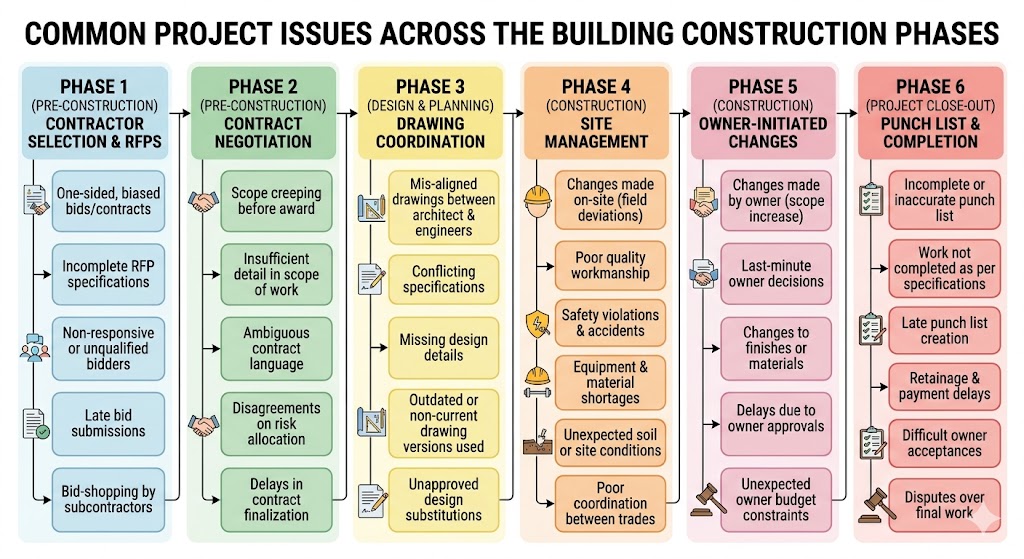
    Many people think issues arise solely because someone changed their mind. But the reality is that design and construction are complicated processes where issues can crop up at any time. Gaps naturally form between:

    • The Owner’s Vision (What you want)
    • The Designer’s Plan (What is drawn)
    • The Contractor’s Execution (What is built)

    Usually, everyone is trying their best. But everyone is also moving fast. Small assumptions made by an engineer or a sub-contractor can snowball into massive headaches by the time they reach the “Punch List” phase.

    Catching the “Project Drift”

    A problem on your job site today usually didn’t start today. It likely started weeks ago during a meeting or a “quick” email thread.

    That’s how projects lose their way—we call it Project Drift. A missing detail in your initial RFP becomes a surprise cost six months later. An assumption about a finish material becomes a disagreement during installation.

    By the time you see the problem, you’re already paying for it.

    Why Brixzly is Different

    We didn’t build Brixzly for “the industry.” We built it for you.

    We know that property owners aren’t looking for another complex technical tool. You’re looking for visibility.

    Brixzly was designed to close the gap between you and your project team. It’s about making sure that:

    • You are aligned with your team from Day 1, not just when things go wrong.
    • The information is easy to understand, even if you aren’t a pro.
    • Hidden issues are surfaced early, while they are still cheap and easy to fix.

    Your Project, Your Peace of Mind

    There’s no app that can make construction “simple”—it will always be complex. But Brixzly makes it clear.

    We aren’t here to replace the expertise of your architect or the skill of your builder. We’re here to make sure everyone is working from the same page—literally.

    Because when everyone has a clear understanding of the project, the only surprise should be how much you love the finished result.

  • Why Comparing Construction Bids Is So Hard (And Why That’s Expensive)

    Why Comparing Construction Bids Is So Hard (And Why That’s Expensive)

    There’s a moment in every project that feels like it should be the easy part: the drawings are out, the bids are in, and now you just have to pick one… Except it’s never that clean.

    The numbers are usually all over the place, and even though the scopes look similar on the surface, you can tell something is off. When you start digging, you realize you aren’t even sure what you’re comparing anymore. Of course, every bidder will tell you they priced exactly what was in the drawings—but someone is wrong. They just don’t know it yet.

    Where things actually go sideways

    I don’t think most people realize how much interpretation happens during a bid. Contractors are moving fast, often pricing three projects at once and making judgment calls on details that aren’t fully resolved. Meanwhile, design teams are fielding RFIs from multiple bidders while juggling other work. Nobody is trying to cut corners here; it’s just the nature of the beast.

    Drawings are complex and layered across disciplines. Architecture might say one thing, while the structural set says something slightly different, and a tiny detail in the mechanical set touches both. A contractor has to make a call, so they do. Another contractor makes a different one, and a third carries an allowance just to hedge their bets. You end up with the same drawing set producing three totally different sets of assumptions.

    What you’re actually choosing between

    When you sit down to compare those bids, you aren’t comparing prices—you’re comparing interpretations. The frustrating part is that when you ask why a number is high or low, every answer sounds reasonable. Both can be true, but neither tells you if the bid actually covers the job. Most owners just make the best guess they can and pray the gaps show up early rather than late.

    How we’re changing the dynamic at Brixzly

    We built Bid Scope to fix that baseline.

    If you’re still in the bidding phase, the tool generates a structured scope document directly from your drawing set—reading architectural, structural, mechanical, and electrical plans together. It organizes everything by CSI division and pulls quantities automatically. Instead of five contractors guessing at the blanks, everyone starts from the same concrete document. You’re finally comparing actual prices, not five different reads of the same blueprints.

    Even if you already have bids in hand, it helps you spot where a scope might have been misinterpreted. It tells you exactly which clarifications to ask for so you aren’t blindsided by a change order six months down the line.

    It’s not just about the owner

    Contractors carry a ton of silent risk on things they think are covered but aren’t explicitly in the scope. When the baseline is clearer, that risk disappears. Designers win, too—a lot of late-stage coordination headaches are just bid-phase assumptions finally catching up to the project.

    We didn’t build this because the bidding process is “broken.” It’s just unnecessarily hard. We’ve watched too many owners make smart decisions based on the info they had, only to get hit later by something that was technically in the documents but buried under a hundred sheets of paper.

    Construction will always require human judgment, but understanding a project shouldn’t depend on who had the most time to read every single note.

    What’s next: Once you have a shared scope, the next question is how you actually get it in front of the right contractors — and how you make sure everyone responds to the same thing. In the next post, I’ll walk through how Brixzly’s RFP Manager uses that scope to create and send RFPs, and what it looks like when the process is tracked in one place from the start.

  • A First Look at Brixzly

    A First Look at Brixzly

    What It Actually Does (and What It Doesn’t)

    After talking with owners, contractors, architects, and engineers, one question comes up again and again:

    “So what exactly is Brixzly?”

    The short answer is this:

    Brixzly helps teams see what’s already in their drawings — faster, clearer, and more consistently — so decisions don’t depend on who had time to search the PDFs.

    But to explain that properly, it’s just as important to say what Brixzly isn’t.


    What Brixzly Is Not

    Brixzly is not:

    • a replacement for architects or engineers
    • a design generator
    • a one-click “perfect coordination” promise
    • a tool that rewrites drawings
    • a black-box AI making decisions for you

    Design judgment, engineering expertise, and field experience still matter — deeply.

    Brixzly exists to support those skills, not override them.


    What Brixzly Actually Does

    At its core, Brixzly works where most projects already live today:

    in real drawing sets.

    PDFs.

    Multiple disciplines.

    Multiple revisions.

    Imperfect coordination.

    Instead of asking teams to change how they work, Brixzly adapts to reality.


    1. It Reads Drawing Sets Like a Team Would — Not Like a Machine

    Brixzly analyzes architectural, structural, mechanical, and electrical drawings together — not in isolation.

    It looks for:

    • how systems relate
    • where scopes overlap
    • where details imply assumptions
    • where information exists but isn’t obvious

    This mirrors how people review drawings — just without the fatigue.


    2. It Surfaces What’s Easy to Miss

    Most coordination issues aren’t dramatic clashes — they’re subtle.

    A missing note.

    An implied condition.

    A detail referenced three sheets away.

    A scope gap between disciplines.

    Brixzly surfaces:

    • key quantities and scope indicators
    • system interactions across disciplines
    • inconsistencies between drawings
    • areas that deserve a second look

    Not to declare problems — but to invite better questions earlier.


    3. It Brings Consistency to Bidding and Review

    For owners and preconstruction teams, Brixzly helps turn drawing complexity into something comparable.

    Instead of relying on:

    • assumptions
    • exclusions buried in proposals
    • allowances used as placeholders

    Brixzly helps establish a clearer baseline — so bids are evaluated on the same understanding of scope.

    That alone changes the conversation.


    4. It Speeds Up Review Without Rushing Decisions

    Brixzly doesn’t make decisions for you.

    It gives you:

    • faster access to relevant information
    • fewer blind spots
    • more confidence that nothing obvious was missed

    That means teams spend less time searching — and more time deciding.


    Why This Matters

    When clarity improves:

    • owners make better choices
    • contractors price with less hidden risk
    • architects and engineers get fewer late surprises
    • coordination improves earlier, not later

    The result isn’t automation.

    It’s alignment.


    Why We’re Building Brixzly This Way

    Brixzly isn’t built for a perfect, fully BIM-coordinated future.

    It’s built for:

    • the project you’re working on right now
    • the drawings you already have
    • the constraints you can’t change

    Because progress in construction doesn’t come from pretending complexity doesn’t exist — it comes from managing it better.


    What Comes Next

    This is just the beginning.

    Over the coming posts, we’ll share:

    • how Brixzly supports owners during bidding
    • how it fits into preconstruction workflows
    • real use cases and examples
    • and how teams are already using it to reduce friction

    Not as promises — but as proof.

    Because clarity shouldn’t be optional.

    And coordination shouldn’t depend on who stayed up the latest.

  • The Real Problems Brixzly Solves

    Why Drawing Sets Create Friction

    If you’ve ever tried to navigate a full architectural drawing set — whether as an owner reviewing bids, a contractor preparing pricing, or a design team coordinating disciplines — you already know this truth:

    The information you need is always there… but never where you need it, when you need it.

    Owners feel overwhelmed.

    Contractors feel uncertain.

    Architects and engineers feel rushed and reactive.

    Everyone feels like they’re working from different realities.

    This is the invisible friction point in construction — and it’s the reason Brixzly exists.

    Why Drawings Slow Us Down (Even When They’re Good)

    A drawing set is meant to be the project’s source of truth. But in practice, it becomes:

    • 450+ sheets
    • in 6–8 disciplines
    • revised multiple times
    • each containing details the other needs, but may not see

    So what happens?

    Everyone is searching.

    Searching for door tags, wall types, fire ratings, fixture counts, roof slopes, MEP routing, structural embeds, finish specifications — the list never ends.

    Hours are spent not designing, not building, not deciding — but hunting.

    That’s not inefficiency. That’s lost opportunity.

    Where Owners Get Stuck

    Owners want clarity — not guesswork.

    But what they receive during bidding looks like:

    • apples-to-oranges proposals
    • allowances that don’t align
    • scope gaps buried in footnotes
    • exclusions that appear after contract signing

    When owners can’t compare bids clearly, they default to the lowest number — even if it isn’t the real number.

    Brixzly changes this by extracting scope clearly, consistently, and transparently.

    Where Contractors Get Stuck

    Contractors are not confused — they are overloaded.

    A single RFP often requires:

    • manual takeoffs
    • cross-referencing between architecture, structure, and MEP
    • clarifications that go unanswered
    • risk carried silently because time ran out

    And because drawings don’t always coordinate, bidders price what they assume is intended — not what is explicitly documented.

    That gap becomes the change order nobody wanted.

    Where Architects & Engineers Get Stuck

    It’s not that drawings are incomplete — it’s that project velocity has outpaced traditional documentation.

    Designers juggle:

    • accelerated deadlines
    • multiple stakeholders
    • incomplete owner directives
    • late engineering adjustments
    • shifting scope priorities

    AI isn’t here to replace expertise — it’s here to give design teams breathing room before coordination issues become field issues.

    So What Does Brixzly Actually Fix?

    Brixzly doesn’t rewrite drawings.

    It doesn’t redesign buildings.

    It doesn’t replace professional judgment.

    It clarifies what’s already there:

    • key quantities
    • system interactions
    • scope expectations
    • discipline overlaps
    • missing detail connections
    • bid-level consistency

    It surfaces what drawings often hide:

    patterns, collisions, assumptions, and gaps.

    When information becomes visible, decisions become possible.

    This Is Why Brixzly Exists

    Because owners shouldn’t be guessing.

    Because contractors shouldn’t be carrying silent risk.

    Because architects shouldn’t be navigating coordination in the eleventh hour.

    Because construction shouldn’t depend on who has more time to search PDFs.

    Brixzly is built for the real world:

    • PDF-heavy workflows
    • late-stage revisions
    • imperfect coordination
    • tight deadlines
    • multi-party decision-making

    It’s not hype.

    It’s help.

    A tool that doesn’t claim to replace anyone — but supports everyone.

    From Founder to Industry

    I didn’t build Brixzly to chase a trend. I built it because I’ve watched too many talented people work too hard for information that should have been available with a click.

    The AEC industry doesn’t lack intelligence, dedication, or expertise — it lacks access to clarity in real time.

    If AI can solve that, even partially, then the future isn’t automation — it’s alignment.

  • AI in Design & Construction

    AI in Design & Construction

    Where the Industry Really Stands — and Where Brixzly Fits In

    In an era where artificial intelligence is transforming nearly every major sector, the design and construction world remains both full of potential and surprisingly behind the curve. While finance, healthcare, and logistics have embraced AI-driven workflows, the AEC industry (architecture, engineering, and construction) still relies heavily on manual processes, disconnected tools, and mountains of unstructured data.

    At Brixzly, we see this gap every day. Owners, architects, engineers, and contractors are producing incredible work under immense pressure—but they’re doing it with tools that haven’t kept pace with today’s challenges. AI is poised to change that, but adoption remains inconsistent and uneven.

    The Challenges AEC Faces Today

    Design and construction teams navigate complexities that few outsiders ever see:

    • Tight schedules and shrinking budgets
    • Fragmented communication across multiple disciplines
    • Drawings that change frequently—and don’t always coordinate
    • A critical shortage of skilled labor
    • High liability and high stakes
    • Thousands of pages of plans, details, and code requirements
    • Owners left navigating unclear bids, inconsistent scopes, and limited visibility

    This is exactly where AI should shine. It can analyze massive data sets, understand relationships between building systems, cross-check disciplines, and surface issues before they become costly.

    Yet widespread adoption hasn’t happened—yet.

    Where AI Is Making Real Progress

    Though early, real-world AI applications are already reshaping parts of the AEC process.

    1. Automated Drawing Intelligence

    AI is finally able to extract key information from drawing sets—identifying walls, doors, structural elements, equipment tags, materials, and even generating quantities.

    This foundational capability aligns directly with Brixzly’s vision:

    • Professionals spend less time searching drawings
    • Owners get clearer scopes and more accurate bid comparisons
    • Contractors receive cleaner, more consistent information from the start

    2. BIM-Enhanced Analysis

    AI layers applied to BIM models can detect clashes, identify missing documentation, and analyze model quality. But this only works when BIM is properly managed—something that varies significantly across firms.

    Brixzly helps bridge this gap by providing structured insights even when a project relies heavily on PDFs rather than BIM.

    3. Jobsite Computer Vision

    AI-powered cameras are being used to:

    • Monitor safety compliance
    • Track field progress
    • Compare installation to plan
    • Identify schedule deviations early

    This adoption is growing most quickly on large commercial projects—but has yet to become accessible to smaller contractors or owners.

    4. Predictive Analytics

    Machine learning models are beginning to predict:

    • Delays
    • Cost overruns
    • Equipment failures
    • Procurement risks

    But widespread usefulness depends on having reliable, consistent project data—a challenge for much of the industry.

    Where AI Adoption Is Still Limited

    Despite innovation, many systemic barriers remain.

    1. Small and Mid-Sized Firms Are Largely Excluded

    Most AI tools target enterprise clients.

    The majority of the industry—small firms, local contractors, and individual owners—rarely have access to advanced tools.

    Brixzly’s approach is built to reverse this trend.

    2. Multi-Discipline Coordination Still Requires Manual Review

    Architectural, structural, MEP, site, civil—designs still clash.

    And most coordination still involves flipping through PDFs, manually marking issues, and relying on human memory.

    3. The Industry Still Relies on 2D Drawings

    Even on BIM projects, communication typically happens through exported PDFs.

    AI can read them—but structured, machine-readable data is limited.

    Brixzly is designed to make PDF-based projects far smarter, bridging the gap between where the industry is and where it’s going.

    4. Resistance to Risk and Change

    Construction is cautious for good reason: mistakes are expensive.

    Professionals and owners alike hesitate to trust automation unless it’s transparent, accurate, and grounded in how real projects work.

    The Future: AI as a Partner, Not a Replacement

    The next generation of AEC tools—including Brixzly—focuses on AI that works with owners and professionals, not instead of them.

    What this looks like:

    • Automating repetitive drawing analysis
    • Surfacing coordination inconsistencies before they escalate
    • Reviewing multi-discipline drawings instantly
    • Generating early-stage cost and material insights
    • Supporting owners with clearer scopes, apples-to-apples bids, and transparent assessments
    • Helping designers see system relationships early
    • Reducing manual takeoff, markups, and cross-referencing
    • Enhancing communication between contractors, engineers, and architects

    AI won’t replace creative judgment, field experience, or engineering expertise—but it will reshape how efficiently those skills are applied.

    The Opportunity Ahead

    The gap between AI’s potential and its current adoption is exactly why Brixzly exists.

    Our mission is to bring powerful, accessible AI tools to the entire design and construction ecosystem:

    For Owners

    • Clearer bid scopes
    • More consistent contractor proposals
    • Faster drawing assessments
    • Better decision-making with objective, AI-driven insights

    For Architects & Engineers

    • Automated drawing intelligence
    • Faster cross-discipline integration
    • Fewer missed details or coordination surprises

    For Contractors

    • Cleaner scopes
    • Better visibility into design intent
    • Stronger preconstruction accuracy

    AI in AEC is not a distant future.

    It’s the next essential step.

    And the owners, designers, and builders who embrace it early will define the next decade of construction.

top